The short answer
Tabby, tortoiseshell, calico and tuxedo are coat patterns, not breeds. Nearly every cat wears a tabby pattern under whatever else it has, most ginger cats are male and almost every tortie and calico is female, and the vast majority of cats you meet outdoors are moggies rather than any breed at all.
You already know some of these cats by sight. The stripy one on the wall by the bins. The black and white one in the first floor window above the launderette. The ginger that walks the length of the terrace at about four in the afternoon. What you probably do not have is a name for what you are looking at.
None of those are breeds. Tabby is not a breed. Calico is not a breed. Tuxedo is not a breed. They are patterns, and they are worth knowing, because a coat is the one thing about a cat you can read properly from ten feet away without bothering it.
Tabby is a pattern, and nearly every cat is wearing one
A single hair on a tabby's flank is banded: pale, dark, pale. That banding is called agouti, and it is the default setting for domestic cats. The stripes and swirls you can see are the parts of the coat where the banding stops and the hair goes solid dark instead.
Solid black cats are tabbies too. They carry a gene that fills in the pale bands across the whole animal. Find a black cat in low afternoon sun and you can often see the pattern still down there, faint stripes or rings, usually called ghost markings. Same tabby, painted over.
Tabby comes in four patterns, and you will meet all four on an ordinary street.
Mackerel
Narrow stripes running down the ribs from a dark line along the spine, like the bones of a fish. This is the oldest of the four, the pattern the African wildcat wears, and the one you will see most often. The stripes are frequently broken into dashes rather than running clean to the belly.
Classic
Also called blotched. Wide swirls instead of narrow stripes, with a spiral on each flank that people call the bullseye, and a smeared shape over the shoulders that looks vaguely like a butterfly with its wings open. Classic is recessive to mackerel, so a cat needs it from both parents to show it.
Spotted
The stripes are broken up into spots, anything from small dots to fat ovals. Check the legs and tail, which usually keep their rings even when the body has gone entirely to spots.
Ticked
The banded hairs are all there, but they barely gather into a pattern anywhere on the body. A ticked cat reads as plain sandy or plain grey at a distance and then resolves into something finely speckled up close. The giveaway is the face, legs and tail, which normally hold on to faint bars.
Quick test on a cat that will not sit still. Look at the flank, not the back. Lines running down the ribs is mackerel. A wide swirl with a dark centre is classic. Broken dots is spotted. Almost nothing on the body but a ringed tail is ticked.
The M on the forehead
Every tabby has one: two dark lines that run up over the eyes and meet in a rough M between the ears. There is folklore attached to it in several traditions, and all of it is more interesting than the real answer, which is that the M is simply where the head stripes happen to converge.
It is still the most useful mark on a cat. If you can find the M, you are looking at a tabby, even when the rest of the coat is tortoiseshell, or half covered in white, or so dark you can hardly see anything at all.
Ginger cats, and why most of them are toms
Ginger, orange, marmalade, red: one thing under four names, and the gene responsible sits on the X chromosome. A male cat has a single X, so one copy is enough to make him ginger. A female has two, and needs it on both. That is harder to come by, which is why roughly three in four ginger cats are male. It also means a ginger female always has a ginger father.
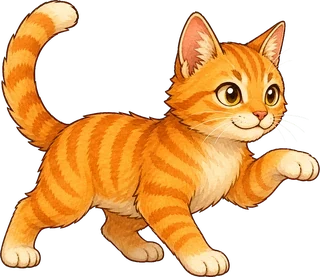
The second thing worth knowing is that every ginger cat is a tabby. The gene that fills in the pale bands and gives you a solid black cat has no effect on ginger pigment, so a plain orange cat does not exist. Look at any ginger asleep on a doorstep and you will find swirls, stripes, or at the very least a ringed tail and an M.
Tortoiseshell and calico, and why they are almost always female
A tortoiseshell is black and ginger on the same cat, brindled together so the two colours run into each other. A calico is that same cat plus white, and the white changes everything about how it looks: instead of mingling, the black and the ginger sit in separate blocks. In Britain you will just as often hear a calico called tortoiseshell and white.
Both colours come from the same place on the X chromosome, and a cat cannot be ginger and black in the same spot. A female carrying one ginger X and one black X settles it by switching off one X at random in every cell, very early, while she is still a ball of a few hundred cells. Each of those cells goes on to build a patch of skin, and whichever X got switched off decides the colour of the patch. That is why no two torties are marked alike.
A male has one X and nothing to shuffle. Male tortoiseshells and calicos do turn up, at somewhere around one in three thousand, and they almost always carry an extra X chromosome. They are usually sterile.
If a tortie also shows obvious tabby striping running through the ginger, you will hear her called a torbie. It is not an official term. It only means the tabby underneath has not been painted over.
Tuxedo, and everything else the white does
White on a cat is less a colour than a gap. A separate gene stops pigment cells reaching parts of the coat while the kitten is developing, and it works from the belly outwards and the feet upwards. That is why cats have white socks, white bibs and white chins, and almost never a white spine.
How much white you get is a sliding scale, and the names people use are just points along it.
None of these are breeds either, and they stack. The same cat can be a mackerel tabby and a tuxedo at once, which is exactly what most black and white striped cats are. Nearly every honest description of a street cat is two or three of these words in a row.
A cat that is white all over is a different case, and there is one thing worth carrying with you. Congenital deafness is common in all-white cats, especially those with two blue eyes. If a white cat outdoors does not react when you speak to it, it may not be ignoring you. Give it more room rather than less, and never come at one from behind.
Colourpoint
A pale body with a dark face, ears, paws and tail. The dark parts are not decoration. The enzyme that produces pigment in these cats only works properly below normal body temperature, so colour develops on the cooler ends of the animal and gives up in the warm middle. Kittens are born almost white, because the womb is warm, and the points come in over the following weeks.
Two things follow that you can check on a walk. Colourpoint cats always have blue eyes. And a colourpoint that spends its winters outdoors will be visibly darker than one that lives on a radiator, with the same cat often darkening as it ages.
Almost every cat you meet is a moggie, and that is the good news
A moggie is a cat of no particular breed, which covers nearly all of them. The cat on the wall is not a Bengal because it has spots, and the big fluffy one is not a Maine Coon because it is big and fluffy. Breed is ancestry. Pattern is paint. Several pedigree breeds were built by picking out a pattern that was already common in the ordinary cat population and fixing it in place.
This matters for a practical reason. A coat tells you almost nothing about what a cat is like. There is a stubborn belief that gingers are daft and torties are difficult, and any shelter will tell you they see every temperament in every colour. The one real effect colour has on a cat's life is that black cats get passed over and wait longest for a home, which is a fact about people and not about cats.
What to do with this on a walk
Naming a pattern is really just a way of making yourself look for longer, and looking for longer is most of what being good with cats consists of. The rest is restraint.
- Stop short and crouch or sit down. A standing human is a large thing arriving.
- Let the cat close the gap. If it wants to, it will. If it does not, that is the answer and it is a fine one.
- Do not follow a cat into a garden, a driveway or a doorway. Someone lives there, and so, usually, does the cat.
- Do not feed a cat you meet. Plenty of outdoor cats belong to somebody, some are on prescription diets, and food left near a road pulls cats towards the road.
This is the habit PoCats is built around. You photograph a cat you have genuinely met, and it becomes a card in an album, cut from your own photo with nothing redrawn, so the coat comes with it exactly as it was. After a few weeks you have a row of cards where you can see for yourself that the wall cat is a classic tabby and the one outside the chip shop is a mackerel. It is free, and nothing you could pay for changes what you catch.
But none of the above needs an app. Next time you pass the stripy one by the bins, look at the flank and check for a spiral. That is one word you have this evening that you did not have this morning.
Questions people ask
What is the difference between a calico cat and a tortoiseshell cat?
Both are black and ginger on the same cat. A tortoiseshell has the two colours mingled and marbled together, with little or no white. A calico is the same combination plus white patches, and the white makes the black and ginger sit in larger, cleaner blocks instead of blending. In Britain, calico is often just called tortoiseshell and white.
Why are most ginger cats male?
The gene that makes a cat ginger sits on the X chromosome. A male has one X, so a single copy is enough, while a female has two X chromosomes and needs the gene on both. That is why roughly three in four ginger cats are toms, and why a ginger female always has a ginger father.
Is tabby a breed of cat?
No. Tabby is a coat pattern, not a breed, and it turns up in dozens of pedigree breeds as well as in ordinary moggies. It comes in four patterns: mackerel, classic, spotted and ticked. Every tabby also carries the M-shaped marking on the forehead.
Why do tabby cats have an M on their forehead?
The M is simply the point where the stripes on a tabby's head converge above the eyes. It is not a separate marking and it does not indicate anything about the cat. It is useful for identification though: if you can see the M, you are looking at a tabby, even if the rest of the coat is tortoiseshell or mostly covered in white.

Free tools for your next cat encounter
Make a keepsake with the cat card maker, using a photo you own. For your next walk, the body language decoder reads a cat's tail, ears and eyes back to you, and the street cat name generator names the one that has been sitting on your wall all summer.
Where this fits in PoCats
PoCats is a cat spotting game: you photograph a real cat you meet, it is checked as a living animal, and it becomes a collectible card cut from your own picture. The catch itself is a two-second timing moment you can try in your browser, and the whole loop is explained here.
 PoCats